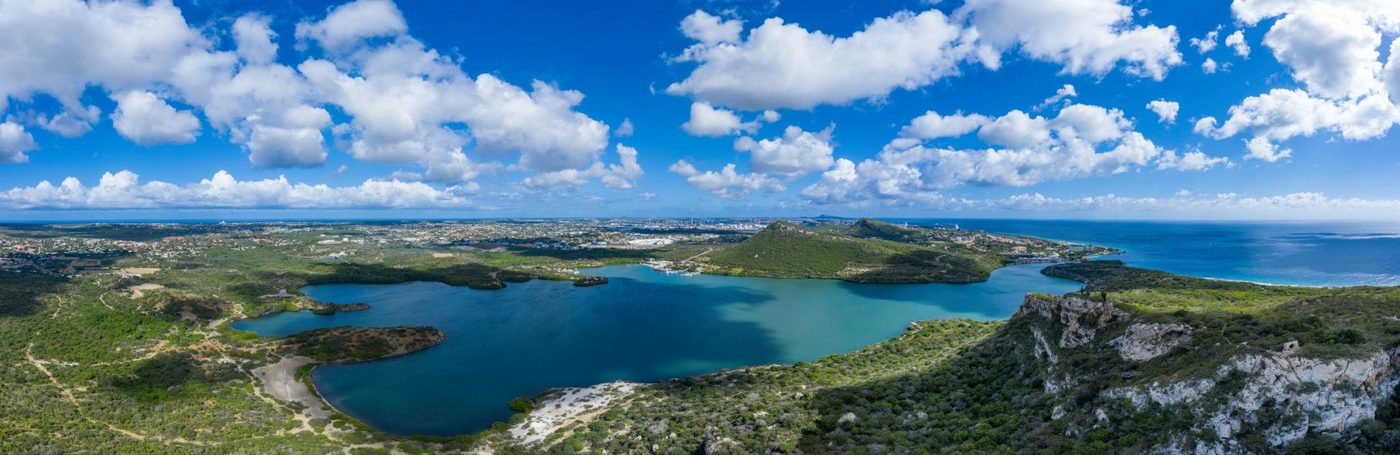
Buying land in Curaçao looks like the smart entrepreneurial play: get in cheap, build exactly what you want, capture the developer's margin yourself. Sometimes it is. But the island is dotted with half-built concrete skeletons owned by foreigners who learned the hard way that a cheap plot is not the same as a buildable one. Read this before you fall in love with a view.
What land costs per square meter right now
| Land type | USD per m² | Notes |
|---|---|---|
| Oceanfront lot | $250 – $700+ | Coral Estate, Cas Abao area, Westpunt coast. Trophy parcels exceed this. |
| Hillside with sea view | $100 – $250 | West-side developments, hills around Spanish Water command the top of the range. |
| Inland residential | $40 – $120 | Established neighborhoods with utilities at the road are worth the premium over raw acreage. |
| Commercial-zoned | $150 – $400 | Willemstad corridor, near the airport, main roads. |
A typical 1,000–1,500 m² residential building lot in a decent development runs $60,000–$180,000. Add the build and you'll understand why finished homes in the same areas sell for what they do.
The infrastructure questions that decide everything
Ask these four questions before anything else. Water: is there an Aqualectra connection at the plot boundary? Extending mains water hundreds of meters costs serious money; trucked water and cisterns are the fallback and shape how you build. Electricity: same utility, same question — connection at the road is cheap, extension is not. Sewage: most of the island is on septic/cesspit, which is normal and fine, but rocky ground makes excavation expensive. Internet: fiber now covers much of the populated east; the west and remote parcels rely on fixed wireless. A plot in an established verkaveling (subdivision) with utilities stubbed to the boundary is worth a large premium over raw land that's "only 200 meters from the grid." Those 200 meters can cost more than the land.
Permits, building costs, and the real timeline
You'll need a building permit (bouwvergunning) from the government's planning office, based on stamped architectural drawings — budget several months for approval, longer if the parcel touches protected coastline or conservation zones. Developments like Coral Estate add their own architectural review on top. Real-world build costs in 2026: roughly $1,400–$2,200 per m² for quality residential construction, more for high-end finishes, infinity pools, and difficult (rocky, sloped) sites. Materials are largely imported; prices and timelines reflect that. A realistic start-to-keys timeline for a custom home: 18–30 months from land purchase. Anyone promising 12 is selling something.
Zoning pitfalls: the nightmare scenario
Curaçao's development plan (EOP — Eilandelijk Ontwikkelingsplan) classifies every parcel: urban residential, rural, open land, conservation, and more. The nightmare scenario is real and recurring: a foreigner buys a gorgeous cheap parcel that turns out to be zoned open land or conservation area where residential construction is prohibited or severely restricted — or buys agricultural huurgrond (leased government land) that cannot be built on or transferred as expected. The land wasn't cheap; it was worthless for their purpose. Before offering: get the zoning designation in writing from the planning office, confirm tenure (eigendom vs. erfpacht vs. huurgrond) at the notary, and check the kadaster survey against what the seller showed you on the ground. Fences lie.
Is land a good investment if you don't build?
Carrying costs are low — modest annual property tax and basically no maintenance — which makes land banking cheap to hold. But appreciation is slow and lumpy: raw land in unremarkable locations has historically appreciated slower than built property, and it produces zero income while you wait. The exceptions that have rewarded patience: parcels inside successful developments (Coral Estate lots have appreciated meaningfully), coastal land near tourism growth, and anything near new infrastructure. If you're not building within 3–5 years and the parcel isn't in one of those categories, you're probably better off buying a rentable property instead.
Build vs. buy existing: the honest math
Take a 3-bedroom, 200 m² home with a pool in a good area. Buying existing: $400,000–$500,000, done in 8 weeks, rentable immediately. Building: lot $100,000–$150,000 + construction $300,000–$440,000 + architect, permits, landscaping, pool, connection fees (add 10–15%) = $450,000–$650,000, and 2+ years of your attention, currency exposure on materials, and contractor management from abroad. Building wins only when you genuinely can't buy what you want, you'll be on-island during construction, or you're capturing a truly underpriced lot. For most foreign buyers, the developer's margin is the fee you pay to skip two years of headaches — and it's usually worth paying.
I know which parcels are actually buildable and which are someone else's abandoned dream. Let me save you from buying the wrong plot.
Get a hand-picked shortlist (free)
Tell me what you're looking for. I'll reply personally with a short, honest list of options that fit — including properties that aren't on the big portals — plus the free 2026 Buyer's Blacklist: 12 property traps foreign buyers keep falling into.